All About Cats
Cats, Kittens and Feline Fun!
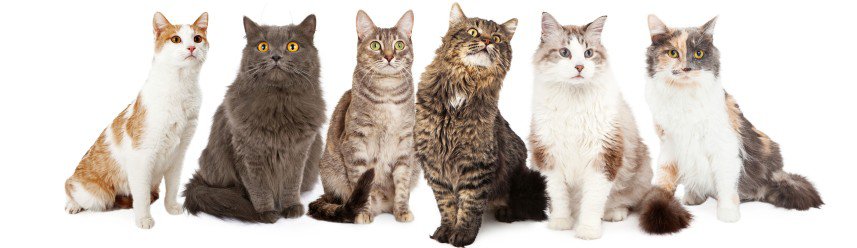
=^..^= Meow and welcome to I-Love-Cats.com! If you love cats & kittens, here you can discover many things about the world of cats, and enjoy many free feline related information and pictures. Find out all about Cute Cats on I-Love-Cats.com! Cute Cat Pictures, Cat History, Cat Breeds - all you need to know!
Everything You Need To Know About Cats
The medical or scientific name for cats is Felis Catus, aka the domestic cat and house cat. They are domesticated members of the Felidae and belong to the order of Carnivora. Plus, Felis Catus is the smallest member of this family.
Domestic cats are best characterized by their supple, low-hung look, with strong molded heads, long tails (some have short tails too), with sharp teeth and claws. They are excellent hunters and prefer to venture out for food at night. Plus, they possess other features of their wild cousins, besides being carnivorous, which include being powerful, remarkably agile, territorial, and excellent coordination.
It is worth mentioning that ancestors of another household pet, i.e., the dog were social animals known for living in packs with a leader. However, dogs transferred their allegiance from the leader of the pack to a more robust, smarter master, i.e., humans.
That said, cats aren't easily subjected because they were never as social. That's why they revert to self-reliance more readily and often with a high degree of success than most domestic dogs.
- What's The Origin And History Of Cats?
- How Did Cats Get Domesticated?
- What Are The Feline Associations With Human Culture?
- What Are General Features And Special Adaptations Of Cats?
- What Types Of Coordination And Musculature Do Cats Have?
- How Do Cat Claws Work?
- How Are Cat Teeth?
- How Do Cat Senses Work?
- What Are The Different Cat Breeds?
What's The Origin And History Of Cats?
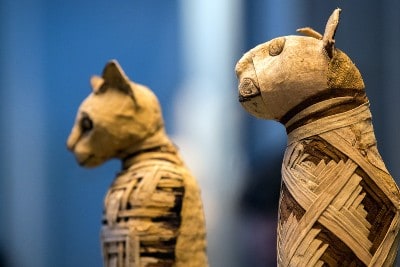
The history of cats can be traced back to ancient Egypt, where humans and felines coexisted. In Ancient Egypt were worshiped, pampered, and statues of them with pharaohs can still be seen at the Cairo Museum.
The cats were interbred with the African wildcat, a subspecies of Silvestris lybica. Today, cats are the most common household pets.
Cats emerged during the early Pliocene period, which lasted 5.3 to 3.6 million years. Since then, cats have continued to evolve with minimal change, even exhibiting the appearance of a distinctive blotched pattern on their coat. Today, they are known as lap cats.
In recent years, scientists have conducted genetic studies to reconstruct the evolution of domestic cats. These studies have revealed that domestic cats have the same DNA as wild cats. The ancient feline primarily derives from a single ancestor, Felis silvestris lybica. The domestic cat is a diploid organism with about twenty thousand genes. It evolved from the same ancestor as the wild feline, with minor changes over the centuries.
How Did Cats Get Domesticated?

The domestication of cats has resulted in various advantages, including the widespread adoption of cats as pets and their potential as a predator of rodents. Cats have also become incredibly useful as domestic pets, with multiple breeds, including the so-called stray, among the most common. Over the centuries, domestic cat populations have multiplied dramatically.
Today, there are more than half a billion cats around the world, and this is mainly due to human domestication. Cats and humans have shared a long history, though there is little archaeological evidence to back this up beyond ancient Egypt.
One study claims that cats were domesticated nearly 8,000 years ago in the Fertile Crescent, where they lived alongside people. The other study found that domestication of other animals began in the Fertile Crescent. Scientists think cat domestication resulted from humans deliberately feeding and encouraging cats to hang around as a mouse-killing tool. But the scientists admit that this research is far from definitive, as the evidence is hardly conclusive.
It is evident that cats, especially domestic cats, hardly ever hunt rodents. In fact, dogs are more prolific rodent hunters. So, if cats and dogs were domesticated on the same property, the property owner may find that their dog does a better job of hunting rodents, caring for cattle, and keeping intruders off the property.
What Are The Feline Associations With Human Culture?
Among the oldest recorded cultures, the ancient Egyptians worshipped cats and considered them divine and magical. They revered cats as gods, deified them, and depicted them in art as half-man, half-woman gods.
The Egyptian cat-deities represented power, fertility, and justice. The cat was also a staple of Egyptian life, making it essential to the culture. Ancient Egyptian mummies and art depicted cats as protectors and devoted companions.
While cat-loving humans are now widely accepted worldwide, their history dates back much further. As the earliest civilizations were evolving, attitudes toward cats changed. In the late 18th century, many people believed cats were witches and associated with witchcraft. They were killed to ward off evil spirits, but in some cases, this practice spread the plague, which affected human populations.
However, the public image of cats began to change in the late 19th century in Western Europe.
What Are General Features And Special Adaptations Of Cats?
In addition to their distinctive appearance, cats are highly adapted to their environment. Their eyes are the largest of any mammal and are remarkably sensitive to light. They have large pupils, which can expand or contract depending on light density. Their eyes also have excellent night vision, with protruding eyelids and a 185 degrees field of vision. This specialized vision makes cats a superb choice for hunting because they can detect prey when most predators sleep at night.
The cat's bottom paws have thick, resilient pads that protect its foot and provide a firm grip on various surfaces. Their claws are highly developed and curved, making them better than a dog's. This makes them easier to grasp prey during hunting and slash during fights over territory. Their claws can also be retracted. As cats spend much of their time hunting, they have diverse coats of different colors.
What Types Of Coordination And Musculature Do Cats Have?
Cats exhibit multidirectional movement and have distinct muscle groups. These structures help the animal move across all terrain, from hard floors to sand and snow. During walking, the MG and SOL share forces between them. This interaction facilitates coordination, even between different muscles of the same body.
In addition, these muscles share forces with their counterparts in other body parts. Moreover, a cat's gait reflects its musculature, based on a hierarchy of skeletal muscle groups.
The neurologic system in cats consists of two main parts: the central and peripheral nervous systems. They control various bodily functions when both function correctly, including respiration, heartbeat, digestion, secretion, and balance. These two systems are interdependent and operate in harmony. However, some disorders can lead to deteriorated coordination in cats. Thus, it is essential to diagnose such conditions as early as possible.
When domestic cats experience a loss of muscle coordination, it may be for various causes. A ear infection, for instance, can cause balance problems in cats. An injury to the spine, meanwhile, may result in spinal surgery. If the underlying cause is unclear, the veterinarian may want to investigate the case further via a series of tests. If your cat does not have the required amount of mobility, your best bet is to consult a veterinarian to identify the reason behind it. Suffice to say, it can be something minor to even life-threatening infection.
How Do Cat Claws Work?
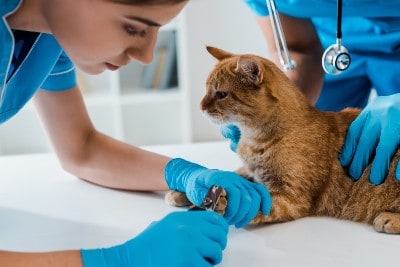
Cat claws are connected to their toes and leg through ligaments and tendons. The phalanges are the equivalent of the fingertips on human hands, and the metacarpal bone is the same as the heel of a hand. Both bones are connected to the skin and are protected by a layer of skin called the quick.
Cat claws also have nerves and blood vessels within them. These are just a few of the many functions performed by these vital body parts.
The nail in a cat's paw is made of a protein called keratin. This protein grows from a blood supply inside the nail. When the blood supply is cut, the outer part of the claw begins to die and becomes a "sheath" surrounding the younger, healthy nail.
A healthy house cat's claw sheds its dead keratin every two to three months. This leaves a claw shell on the scratching post and a healthy nail underneath. Make sure if you take your cat to a professional that they have pet groomer insurance.
How Are Cat Teeth?
Did you know that the mouth of a cat can be extremely dangerous? Cats have sharp, incisor-like teeth that can catch and destroy more than just meat. Cats' teeth are also capable of puncturing the skin of prey.
However, similar to human teeth, they need to be cleaned. Hence, proper oral hygiene is essential for preventing cat tooth decay and loss. If your cat's breath smells terrible, the odds are that it has a mouth infection or a tooth infection. The issue needs to be addressed right away.
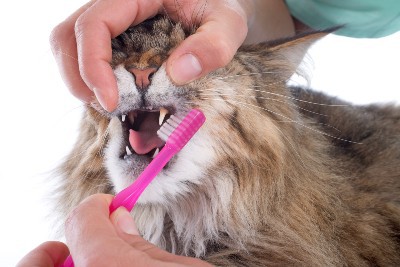
While brushing a cat's teeth, be gentle and try not to agitate the feline. Try to pick a time that is most comfortable for your cat. Always remember to keep your cat near you, and do not hurry. Patience and consistency are crucial to doing it without being scratched.
You can start the process by using sterile gauze strips. When you first brush a cat, approach it from behind and gently tilt its head back to open its mouth. Remember that dental floss is not good for cats, as it can damage their intestinal system.
Cats' dental health is vital to their general wellbeing, so preventative dental care is essential for cats. Dental disease is one of the leading causes of poor quality of life for pets. 50-90% of cats show symptoms of dental disease by age three. While simple cleanings can make your feline friend's mouth look more appealing, you should seek professional treatment to avoid further dental problems.
A veterinarian can perform dental scaling under anesthesia, so be sure to discuss your cat's oral health with your vet.
How Do Cat Senses Work?
Cats are excellent observers, and their heightened senses make them seem like super-heroes. Their keen senses of hearing, sight, smell, and touch make them excellent hunters. Even at night and in dim light, they can detect changes in air pressure and smell, using these to their advantage.
Fortunately, this fantastic ability does not come at the expense of their human owners' well-being.
A cat's vomeronasal organ, located on the roof of the mouth, can detect chemical signatures, or pheromones, that allow them to know what they're looking at. That's how cats with open mouths can pick up on the scents of food and other objects, often several meters away.
So, a cat's keen sense of smell can help them detect hidden food and identify potential predators.
What Are The Different Cat Breeds?
There are a few different domestic cat breeds. If you're a cat lover, you may consider adopting one of these breeds. In this section, we go over some of the most popular domestic cat breeds: Abyssinian, Burmese, Siamese, Balinese, Persian, Turkish, and more. However, there are many more breeds, some more obscure or rarer than others.
A listing of the many different types of cat breeds. A cat breed is an intrasubspecific rank for the classification of domestic cats. A cat is considered to be of a certain cat breed if it is true breeding for the traits that define that breed. Various cat registries around the world record and certify the pedigrees of cats.
Only three percent of owned cats belong to a cat breed, and an even smaller percentage of those are suitable as show cats. A registration certificate proves that a cat belongs to a cat breed by showing the cat's pedigree back to at least four generations.
The whole concept of cat breeds is a relatively new one. Two hundred years ago there was no such thing, however today there are almost one hundred cat breeds. Varieties of domestic cat can also be identified by characteristics other than breed. Here you can find a current list of most cat breeds available today:
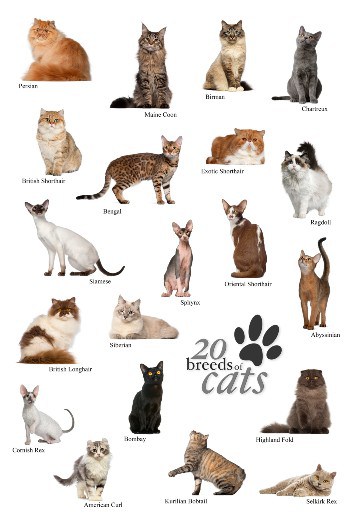
List Of Cat Breeds
Abyssinian - The Abyssinian is a sleek and athletic breed with a short, soft coat. They are highly energetic and require plenty of playtime to keep them happy. They are also intelligent and curious, making them great at learning tricks.
Aegean - The Aegean cat is a breed native to the Aegean Islands in Greece. They are known for their athletic and agile bodies, with long, slender legs and a sleek coat.
American Bobtail - The American Bobtail cat breed is best known for the trait for which it is named: its short, stubby tail, which may be only a few inches long. In fact, American Bobtails' tails are rarely more than half as long as the average cat's tail. This unique trait is the result of a genetic mutation. One of the newest cat breeds, the American Bobtail was developed in the 1970s in, true to its name, the United States. Many people find these cats "dog-like," exhibiting loyalty and athleticism.
American Curl - One of the newest breeds of cat, dating back only to 1981, the American Curl cat breed is known for its distinctive curled-back ears, for which the breed was named. American Curls have a very diverse ancestry, which means they can't easily be pigeon-holed for traits other than the basic physical traits of the breed. In general, they are known to be companionable.
American Shorthair - The American Shorthair cat breed, once simply called the Domestic Shorthair, is thought to represent the cats that lived in North America from colonial times through the late nineteenth century, when foreign cats first came to North American shores in large numbers. Usually known as gentle, playful, and companionable, American Shorthairs are said to be good with children and even dogs.
American Wirehair - An interesting fact about the American Wirehair is that it originated in upstate New York. Though this domestic cat breed has long been well-known, it is now a rare breed. The name refers to its long hair. While it is still an attractive breed, its popularity has declined over the years. However, there are many ways to keep one from becoming extinct. The American Wirehair cat breed has a wavy coat that is compact in size. While it has a low-moderate shedding rate, this breed does require regular brushing and ear cleaning to avoid the accumulation of earwax.
Aphrodite Giant - The Aphrodite Giant is a rare and unusual cat breed that is known for its massive size and stunning appearance. These cats are named after the Greek goddess of love and beauty, and are known for their long, flowing coats and regal bearing. They are affectionate and loyal companions, but require a lot of space and attention due to their size.
Arabian Mau - The Arabian Mau is a medium to large sized breed of domestic cat native to the Arabian Peninsula. They are known for their striking appearance, with a sleek and slender body, long legs, and big, expressive eyes.
Asian - see Korat.
Australian Mist - The Australian Mist cat breed is as Australian as its name. A new breed of cat from the 1980s, the breed is currently largely confined to Australia. Australian Mists are generally playful and get along well with children.
Balinese - The Balinese is a long-haired domestic cat with sapphire-blue eyes and Siamese-style point coloration. These cats have the same long-hair and short-hair coats that Siamese cats have. Balinese cats make beautiful pets and are excellent for beginners. However, their long-haired coats may not suit all homes where some people suffer from breathing issues, allergies, or asthma. The Balinese is a devoted and affectionate domestic cat that loves to interact with its human companions. They are also very intelligent and enjoy socializing with humans. They are great with children and other pets, although they require lots of attention. This breed should live with children and other animals that are used to cats. A Balinese can be quite a handful, so it's best to decide carefully. If you have the patience to train this domestic cat, you'll find it an excellent companion. Balinese cats are very intelligent and have high energy levels. Their high energy and intelligence make them ideal for households that are not constantly on the go.
Bambino - The Bambino cat breed is known for its short legs and elongated body, giving it a unique and playful appearance. They are affectionate and loyal companions, often seeking attention from their owners.
Bengal - The Bengal cat breed is another relatively new breed created as a hybrid between domestic cats and a wild species of cat, in this case, the Asian Leopard Cat (ALC).
Birman - Birmans are distinctive for their striking sapphire-colored eyes and distinctly white paws. The modern breed originated in France in the 1920s and is assumed to have ancestry going back to the country of Burma. Birmans tend to be neither particularly active nor particularly laid-back. They occasionally demand attention, but don't require constant attention. Many people say that Birmans are susceptible to loneliness and benefit from having another cat.
Bombay - The Bombay cat breed was actually bred to look like a small, black Indian panther. Bombays are often thought to be dog-like, even relatively easily trained for a cat, even to the point that some Bombay caretakers walk their cats on leashes.
Brazilian Shorthair - The Brazilian Shorthair is an affectionate cat, so much so that it is often referred to as clingy. Its best match is an owner who will shower it with attention and love while involving it in the activities of the house. Unlike some breeds, which are typically one-man cats, the Brazilian Shorthair is also open to bonding with, and enjoying the companionship, of everyone in the household. If its demands for affection are not met, this frisky, light-hearted cat's temperament can become suspicious and irritable. It may even seek a friendlier owner. Because the Brazilian Shorthair is intelligent, it's a fast learner. An active and playful cat, it is also known for its proud characteristic as an accomplished hunter.
British Longhair - The British Longhair cat breed, also called the Lowlander cat breed, is the fulfillment of a dream among cat fanciers: to once again have a native longhaired cat breed, after the traditional longhaired British cat breed, the Persian cat breed, developed into a very different feline. Today, though still not a hugely popular cat breed, these cats are beloved for their pleasant tempers. British Longhair cats are known as easy to get along with, and generally not so loud. While not extremely playful, they are generally able to have fun and find things to do. They can also be affectionate with people and other cats.
British Shorthair - The British Shorthair cat breed is the grand old lady of British cat breeds, being the earliest breed to establish itself in the first cat shows in the nineteenth century.
Burmese - The Burmese domestic cat breed originated in the 19th century when Dr. Joseph C. Thompson imported a cat from Burma. Thompson believed that the cat was a separate breed and began a breeding program to prove that it was indeed a hybrid. This cat became known as Wong Mau and is considered the ancestor of the Burmese breed. Burmese cats are highly affectionate and loyal; they can also be very playful and will chase a mouse or a stuffed animal if left alone for too long. A Burmese cat's unique appearance is impressive in its own right. The breed is long and powerful, with excellent muscle tone. Its ears have rounded tips, a long body, and tiny oval feet. While highly intelligent and playful, it gets along with other cats quite well. Burmese cats are also called a "dog-cat" due to their ability to hold lengthy conversations and perform tricks.
Burmilla - The Burmilla cat breed, a cross between Burmese and Chinchilla Persian, is a new breed of cat with roots in the UK, which has also taken root in Australia and Canada. The Burmilla has elements of both the Burmese and Chinchilla Persian cat breeds.
California Spangled - he California Spangled cat is a breed that was created in the 1980s with the goal of replicating the look of exotic cats found in Africa and Asia. They are known for their sleek bodies and distinctive coat patterns, which often feature large spots or stripes.
Californian Rex -The Californian Rex is a medium-sized cat breed with a soft, plush coat and a unique, curly coat pattern. They are known for their friendly and outgoing personalities and make great companions for families and individuals.
Ceylon -The Ceylon cat is a medium-sized breed with a slim and athletic build. They have short, glossy fur that comes in shades of brown, black, and cream. Ceylon cats are known for their intelligence and outgoing personalities.
Chantilly-Tiffany - The breed is very healthy, not given to any particular problems. The Chantilly/Tiffany is a breed of loyalty, and easily becomes a close, affectionate companion that is not overly demanding or mischievous. They are not as placid as Persians, nor as active as Orientals, and are best described as moderate. Usually, they develop particular affinity to one person in the home, with whom they bond, conversing in quiet "chirps" or trills characteristic of the Tiffany.
Chartreux - The Chartreux cat is known for its unique naming system, which involves starting their names with a particular letter of the alphabet and runs on a 20-year cycle. The letters K, Q, and W, are excluded from the names. This makes it easy to tell the age of your Chartreux cat. This breed is also associated with notable owners, including Charles de Gaulle and the writer Colette. The Chartreux is a medium to a large-sized cat with short legs. A breeder once described the Chartreux as a "potato on a toothpick." The Chartreux is a popular domestic cat breed in Europe. However, the breed does have health concerns caused by genetic predispositions. Common issues include heart disease and renal failure. Fortunately, this breed is generally healthier and less likely to have genetic issues than other cats. This is because the breed is closely related to many other breeds, including the Persian, Siamese, and Bengal. In addition, it is highly sociable, which is why it is commonly known as the "house cat."
Chausie - The Chausie is a tall, statuesque cat, upright in stance, medium to large in size, and retains a strong resemblance to its ancestor the Jungle Cat. Do you hunger for a touch of the wild in your cat? The Chausie may be the breed for you. Picture if you can, the grace, size, and exotic aura of a wild jungle cat, combined with the temperament of a domestic cat, and you have something resembling the Chausie. The ideal Chausie has been described as "fearless, but not aggressive."
Chinchilla Persian -The Chinchilla Persian is a breed of cat known for its luxurious, long coat and round face. They are known for their calm and affectionate nature, making them great pets for families.
Chinese Li Hua -The Chinese Li Hua cat is a small to medium-sized breed with a short, glossy coat and a round face. They are known for their playful and energetic personalities and are often described as being "dog-like" in their behavior.
Colorpoint Shorthair - The Colorpoint Shorthair cat breed is a brightly-coated offshoot of the Siamese cat breed. In fact, while in the United States the Colorpoint Shorthair's status as a separate breed is well recognized, in the UK these cats are treated as just a variety of the Siamese cat breed. Colorpoint Shorthairs generally share many traits in common with their Siamese breed cousins. Generally speaking, in terms of compatibility, they are perhaps best known as being relatively less trying for people who are allergic to cats, since they do not have as much dander as most other cats. Likewise, they do not require as much grooming as cats of many other breeds.
Cornish Rex - Cornish Rex cats owe their unique short-fur to a genetic mutation that occurred in a cat in a Cornish barn litter in the 1950s. Cornish Rexes are said to love adventure, enjoying exploring and climbing on everything. However, because of their very light fur coats, they cannot tolerate the cold. In fact, many people claim to notice the cats hanging around radiators, light bulbs-even computer monitors-in search of warmth. Otherwise, Cornish Rex cats are generally thought to be companionable animals and good with children.
Cymric - A long-haired version of the Manx, the Cymric first appeared in Canada in the 1960s in litters of strictly pedigreed cats that had no long-haired animals in their ancestry. The new cats were bred together, and the new breed held true. Cymrics are affectionate, intelligent cats, happiest when they are doing something. They have good mousing ability and enjoy time outdoors, but they are very comfortable in the home as well. They get along well with other animals, including dogs.
Cyprus -The Cyprus cat is a small, fluffy breed with a round face and big, expressive eyes. They are known for their playful and energetic personality, and are affectionate and loyal to their owners.
Desert Lynx -The Desert Lynx is a medium-sized feline with a sleek, athletic build. Known for their intelligence and playful nature, these cats are well-suited for indoor or outdoor living.
Devon Rex - The members of the Devon Rex cat breed are curly-furred, generally playful cats, with distinctive, large ears. Devons are often called "pixie cats," but that's not because of their small size. Rather it's because of how unique they look: their ears are very large, and set low on their broad heads. They also have large eyes and slightly upward-pointing noses. They are also slim and light in body. Another name for these unusual-looking cats is "alien cats."
Domestic Shorthair -The Domestic Shorthair is a breed of domestic cat that is characterized by its short, thick coat and stocky build. They are known for their calm and friendly personalities, making them great pets for families with children.
Donskoy -The Donskoy cat is a hairless breed with a muscular build and large ears. They are intelligent, affectionate, and adaptable, making them great companions for families. They require minimal grooming and have a lifespan of around 15 years.
Egyptian Mau - The Egyptian Mau is a small to medium-sized, short-haired domestic cat breed. It is considered a rare breed due to its naturally spotted coat, which occurs on its fur tips. Egyptian Maus are considered rare because of their natural spotted coat, which makes them a desirable addition to any home. Despite being rare, Egyptian Maus are not as expensive as many other cats. Depending on where you live, you can buy one for as little as $500. Due to the limited genetic background of the Egyptian Mau, certain health, the breed faces a couple of common health issues. While it does not typically require special diets, it can become obese and develop joint problems if left untreated. Therefore, you should consult your veterinarian before introducing an Egyptian Mau to your home.
European Burmese - The European Burmese cat breed is a close relation to the original, American, Burmese cat breed, though the European Burmese today has a decidedly distinctive, more varied coat with up to ten possible colors.
European Shorthair - t is the purest of all breeds, replicating its characteristics naturally without any help from breeders. Each color is recognized as its own breed because of the different genes that go into producing each. The European Shorthair gave us the term "tabby," in a round-about fashion. Weavers in Iraq duplicated the colors and patterns of the cat's coat in the silks they exported to Europe, dubbing the fabrics with the name.
Exotic Shorthair - The Exotic Shorthair cat breed, also simply known as the Exotic cat breed, is an offshoot of the Persian cat breed. The first Exotic Shorthairs were the result of interbreeding between Persians and American Shorthairs. With the denser, shorter coat, the Exotic Shorthair breed is less of a grooming challenge than the Persian, hence the nickname, "Persians for lazy people."
Foldex -The Foldex cat is a small, fluffy breed with a distinctive fold in their ears. They are known for their affectionate and playful personalities, making them great family pets. They come in a variety of colors, including white, black, and tabby.
German Rex - The German Rex is a unique breed of cat with a soft, curly coat and a round, expressive face. They are known for their playful and affectionate nature, and are often described as "teddy bear" cats due to their cuddly appearance.
Havana Brown - While many cat breeds are as precious as they can be, some cat breeds are more like the workhorses of the cat fancy. The Havana Brown breed not only has a simple brown coat; these cats are so eager to please they are almost dog-like-in a nice, thoroughly cat-like way, of course. The Havana Brown breed is thought of as being very intelligent. That is, they are generally more easily trained to fetch than other cats and respond well to praise. Most Havana Browns make excellent show cats.
Highland Fold - Known as the longhaired versions of the Scottish Fold.
Highlander - The Highlander is the complete package, beautiful, domestic yet it has a distinctly different and wild look, it is loving, entertaining, physically sound, and is so much fun. This is a very adaptable and loving breed that is equally happy in a very active or a very quite home. They get along well with children and other pets.
Himalayan -The Himalayan is a domestic cat breed that is named after the Himalayan mountain range. They are known for their long, thick fur and their blue eyes. They are a cross between Siamese cats and Persian cats and are known for their sweet and gentle personalities.
Japanese Bobtail - The Japanese Bobtail cat breed is the quintessentially Japanese cat breed and one of the oldest breeds of cat on earth. Japanese Bobtails are immortalized in the Japanese statues of the cat with one paw raised, gracing the entrances of innumerable Japanese businesses. Japanese Bobtails are widely considered active and intelligent. They also actively seek out the company of human beings. Fun fact: they tend to like to carry things in their mouths. No divas, they are generally thought to travel well and get along well with children, dogs, and other animals.
Javanese - The Javanese cat breed was one of numerous cat breeds developed in the United States in the mid-twentieth century; it is essentially a colorpoint shorthair offshoot of the Balinese breed, which in turn was an offshoot of the Siamese breed. Javanese cats are generally considered easy to care for, and friendly. They often seem to enjoy using their paws as hands, opening doors, quite literally-at least, for cabinet doors.
Khao Manee -The Khao Manee cat is a rare and ancient breed hailing from Thailand. They are known for their striking white coat and bright blue eyes. Khao Manee cats are known to be intelligent, active, and affectionate, making them great companions.
Korat - The Korat is another ancient breed of cat from the Far East, this time from Thailand, where the breed is also called the Si-Sawat. Korats are generally thought to be warm and cuddly, active but gentle.
Kurilian Bobtail -The Kurilian Bobtail cat breed is known for their distinctive short, stubby tails and thick, fluffy coats. They are native to the Kuril Islands and Sakhalin in Russia, and are known for their intelligence and playful personalities.
LaPerm - The LaPerm cat breed is one of a crop of new cat breeds that originated in the US in the last decade of the twentieth century, as breeders and fanciers sought out new genetic mutations with interesting physical features. The LaPerm cat breed is known as active, gentle, affectionate, and also a good lap cat.
Lykoi - The Lykoi cat is a breed known for their unique appearance resembling that of a werewolf. They have a thin coat of fur and a distinctive lack of eyebrows and whiskers. They are known for their playful and energetic personality and make great pets for those who love active and interactive cats.
Maine Coon - Maine Coon Cats have bushy tails, long coats, and distinctive brown, black, and white coats that make them resemble raccoons. The long coats of Maine Coon Cats also resemble those of the Norwegian Forest Cat breed in Europe. Yet this is definitely an All-American breed, whose origins likely go back to the earliest colonial settlers of New England.
Manx - The Manx cat breed is known for the strikingly short tail-some would even say that these cats are tailless. True to their name, these cats originated on the Isle of Man and have been around for at least two to three hundred years. The gene for taillessness, which is dominant, likely resulted from a mutation, which then spread to other cats on the Isle of Man.
Mekong Bobtail -The Mekong Bobtail cat is a breed native to Southeast Asia, specifically Thailand and Laos. It is known for its distinctive short tail and fluffy coat. These cats are affectionate and intelligent, making them great companions. They are also known for their playful and energetic personalities.
Munchkin - The Munchkin cat breed is known for their short legs, which are caused by a genetic mutation. They are playful and energetic, and are often compared to feline versions of Dachshunds. Munchkins are generally friendly and adapt well to living with families and other pets.
Napoleon -The Napoleon cat is a small to medium-sized breed with a stocky, muscular build and a round face. They are known for their playful and affectionate personalities, and their love of attention from their owners.
Nebelung - The Nebelung cat breed is a new cat breed that essentially resembles a longhair version of the Russian Blue cat breed.
Norwegian Forest - he Norwegian Forest cat is a European breed of great, furry cats. Norwegian Forest Cats generally resemble Maine Coon Cats on the other side of the Atlantic. In North America, the breed is also known by the nickname, "Wegie."
Ocicat - The Ocicat breed is known for the unique spotted fur coat. It's one of the new breeds that have originated in the US in the last few decades. Ocicats are named for the ocelot, an endangered species they supposedly resemble with their spotted coats.
Oriental Bicolor - The Oriental Bicolor cat breed is known for its sleek, slender body and striking coat pattern. These cats have a black base color with white markings on the face, chest, and paws. They are intelligent and active, often participating in agility and other performance events.
Oriental - The Oriental cat breed comes in a dazzling variety of coats: longhair, shorthair, and over 300 combinations of colors and patterns. Oriental breed cats are known for being unusually attached to their human families. It is often said they like to follow people around, and can become resentful after any significant separation. In addition, the Oriental cat likes to be playful with people and things, swatting around stray scraps of paper and other objects.
Persian - The Persian cat breed is known for being calm, placid, and loving. Although they are docile, they do not play fetch or walk on a leash. They are incredibly intelligent and are happy with the routine of their home. Persian cats enjoy being petted and love to snuggle with their owners. They are also easy to train. Persian cats make good companions for kids and other pets. This medium-sized breed takes its role as a loving companion seriously. They are extremely affectionate and never hesitate to lick you, but they do not like loud noises. They are not good matches for families with small children or animal rescues. Keeping these cats indoors may not be the best idea either, but they are still a great choice if you want a cat that will love your family. However, the Persian breed can be demanding. Persian cats require a lot of grooming. The Persian cat breed has two coats - a silky topcoat and a cottony undercoat. Persian cats should be brushed daily, preferably backward, to distribute the oils evenly throughout the coat. While they do not shed, Persian cats need regular baths every month. Persians are highly susceptible to obesity, so you will need to spend some time grooming them regularly. A good cat groomer can help you keep your Persian looking great.
Peterbald - The Peterbald cat breed originated in Russia in the 1990s and is known for their slender, athletic build and lack of fur. They are affectionate and intelligent, and can be taught tricks and commands like a dog.
Pixie-Bob - The Pixie-Bob cat breed is a medium-sized feline with a muscular, athletic build. They have distinctive bobbed tails and large, round paws. Their coats can range from short to long, with patterns ranging from solid colors to spotted or marbled. Pixie-Bobs are known for their intelligence and affectionate personalities, making them great companions for families.
Ragamuffin - Despite its name, the Ragamuffin cat breed is a beloved, beautiful purebred. The Ragamuffins are also one of the newest breeds of cat. They were first bred in the 1960s, but they did not achieve Cat Fanciers Association recognition until the 1990s.
Ragdoll - The Ragdoll is an American cat breed with a medium-length, silky, rabbit-like coat. It is best known for its docile and placid temperament and affectionate nature. Ragdolls have a sturdy body with a large frame, proportionate legs, and a soft coat with Siamese-style points. Adult cats can be 15-20 lbs without being considered obese, and a fatty pad under the abdomen is typical.
Russian Blue - The Russian Blue Cat breed is one of the oldest cat breeds, having actually originated in Russia in the nineteenth century or earlier. Today, Russian Blues are widely considered easy to get along with and loving animals to have in the home. Russian Blue cats are generally known as quiet but affectionate. They are also known to get along well with children and other pets. In short, they tend not to be terribly demanding are easy to get along with.
Safari - The Safari cat is a domestic breed that is known for its exotic appearance and outgoing personality. They are a hybrid breed, created by crossing an Asian Leopard Cat with a domestic cat. They are typically medium to large in size, with a long, lean body and distinctive leopard-like spots.
Savannah - The Savannah cat breed is a domestic-wild hybrid. To create Savannahs, cat breeders cross domestic cats of a variety of breeds with an African Serval, and usually then further cross the offspring with other domestic cats. The Serval is a wild animal common in sub-Saharan Africa, but it is sometimes also kept as a pet, and the Savannah breed is known as being very companionable with humans despite its wild ancestry.
Scottish Fold - The Scottish Fold is a relatively recent breed of cat known for distinctive folded ears. Scottish Folds are generally considered laid-back cats, except that they are very attached to their human families and may follow people around the house, hating to be left alone.
Selkirk Rex - True to the name, "rex," which in animals means curly, the Selkirk Rex cat breed is a race of teddy-bear-like curly-furred cats. Selkirk Rexes may require some brushing, but should not be brushed too often if the curly fur is to be maintained.
Serengeti - The Serengeti cat is a hybrid breed that is a cross between a domestic cat and a wild African serval. They are known for their tall, slender build and long legs, as well as their distinctive spotted coat. They are intelligent and active cats that enjoy climbing and playing.
Siamese - The Siamese domestic cat is one of the first distinctly recognized breeds of Asian cats. The Siamese originates from the Wichianmat landrace, one of several cat species native to Thailand. The Siamese cat quickly became one of the most popular breeds in Europe and North America in the 19th century. Today, the breed has more than 200 recognized subtypes. Siamese cats are incredibly intelligent and demanding. Their love of people is unmatched. These cats can entertain themselves by turning on faucets, opening cabinets, and watching television. In addition, they are also excellent with children and can even walk on a leash or play fetch with you. If you are considering a Siamese as a companion cat, be prepared to take a little time to get to know this exotic cat.
Siberian - Siberian cats have long been both Russia's national cat and national secret. The thick-coated Siberian cat breed has only recently made a splash in the West. Siberians are often said to be dog-like: they follow around their human family members loyally and often greet them at the door. They are also known as high-jumpers and quite agile cats.
Singapura - The Singapura is one of the USA's newest breeds of cats, having gotten its start in the 1980s when travelers to Singapore brought the cats over with them and started breeding and showing them. Back in Singapore, many of the cats remained stray street cats. But in 1991 the government of Singapore declared the cats a "living national monument."
Snowshoe - The Snowshoe cat breed is known for its distinctive white paws, resembling snowshoes. They are a medium-sized breed with a muscular build and a short, dense coat. Snowshoes are intelligent and friendly, making them great companions.
Sokoke - The Sokoke cat breed is native to Kenya and is known for its distinctive striped coat. These cats are agile and athletic, with long legs and a lean body. They are intelligent and independent, and are known for their ability to adapt to different environments.
Somali - The Somali cat breed is a longhair offshoot of the Abyssinian cat breed.
Sphynx - The Sphynx cat breed has one great distinguishing characteristic: these cats are utterly hairless, like little wrinkly cat versions of Chihuahuas. Generally, Sphynxes like being with humans, but they are also said to get along with other animals, including dogs. Remember that as a hairless cat, a Sphynx cat is just as likely as you to get cold, so be ready to cuddle up in cold weather.
Thai Lilac - The Thai Lilac cat is a breed of domestic cat native to Thailand. They are known for their unique lilac coloring, which ranges from pale pink to deep purple. Thai Lilacs are generally medium to large in size, with a muscular body and strong legs.
Tiffany - The Tiffany cat is a hybrid domestic cat breed. It originated in Canada in the early 1970s, when a Canadian acreage owner discovered a strange new cat in his garden. The animal was a long-haired, chocolate-and-gold-eyed, semi-foreign cat with unknown ancestry. Eventually, the cat gave birth to kittens that were carbon copies of their mother. Eventually, breeders from Canada rescued the kittens and began re-establishing the "Tiffany" breed in North America. Tiffanies are generally healthy, but they can still develop health issues. The breed is known to develop respiratory or digestive problems. As such, they need to be kept indoors, where they can enjoy a good quality of life. Tiffanies are very sensitive to their owners' emotions and are often a welcome distraction after a hard day at work.
Tonkinese - The Tonkinese breed (also called the Tonkinese breed) is a hybrid of the Siamese and Burmese cat breeds. It is said that Tonkinese cats tend to be the rare cats who actually enjoy playing fetch. Tonkinese cats tend to be vocal, but without quite as piercing a voice as the Siamese cat breed. They are also generally said to be curious and affectionate
Toyger - The Toyger is a designer cat. It is designed and bred with the demands of modern apartment life as a human companion foremost in mind. Glittered, pelted, dramatic pattern appeals to both the high-tech glamour and nature-loving, wild dreams of city-caught people while the laid back, easily trained character of these cats make them a joy to live with.
Turkish Angora - The Turkish Angora cat breed is known for their beautiful, usually white, fur. But these beauties have a rugged history in the mountains of Turkey. Some people claim that Turkish Angoras are comfortable around water, and can even bathe with people. After all, the Turkish Angora is related to the Turkish Van, which is known as the "swimming breed." It is also said that the Turkish Angora breed is not given to being held, but is otherwise affectionate.
Turkish Van - The Turkish Van is a naturally-occurring breed of cat born in the region of Lake Van, Turkey. The Turkish Van cat breed, despite having originated as a natural breed of the mountains, is quite companionable with humans. Vans are also known for being quite active and powerful jumpers. But perhaps their most famous characteristic is their reputation as "swimming cats."
Ukrainian Levkoy - The Ukrainian Levkoy is a relatively new breed of domestic cat, having been developed in the early 2000s in Ukraine. These cats are known for their distinctive "dog-like" appearance, with their folded ears and elongated bodies. They are intelligent, playful, and affectionate, making them great companions for families.
Urals Rex - Russian type found in the middle Urals region since the Second World War. The Urals Rex is not a large cat and has a wavy coat of short or medium length, body is strong and muscular. (Gene causing coat is not that for Cornish, relationship with Devon Rex unknown). Head is equilateral triangle shaped with rounded lines. Tail may have a tufted tip. Semi-longhairs have a looser coat, but are less popular.
York Chocolate - The York Chocolate cat is a rare and unusual breed, known for its rich chocolate-brown coat and striking green eyes. These cats are typically small to medium in size, with a sleek and slender build.


